#145748
Re: Forgotten Hope 2
Hello and welcome back to another Forgotten Hope 2 update.
Today we have another render of another Finnish weapon, the Lahti-Saloranta M/26.
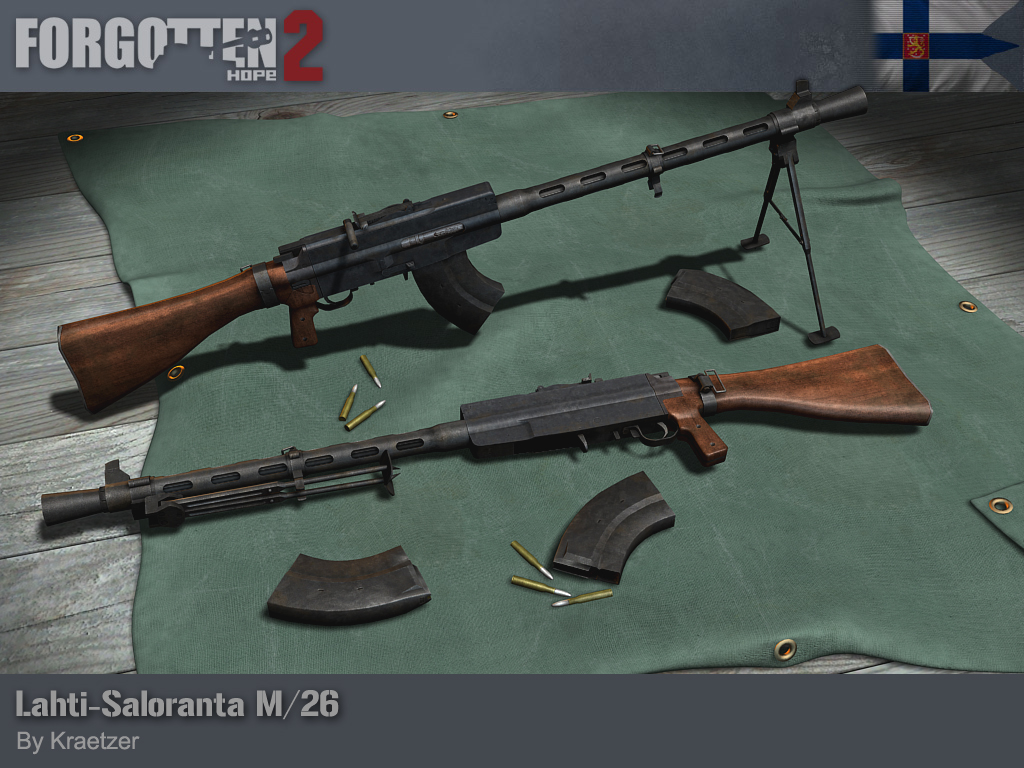
The M/26 started life when Aimo Lahti was looking for things to do following his design of the Suomi KP/31 prototype. When the Finnish Army put out a request for designs for a new light machinegun, Lahti's design was one of those that was considered. Since Lahti had no formal engineering experience, Lieutenant Arvo Saloranta was appointed to assist him.
After acceptance, there were almost constant issues surrounding the weapon. Saloranta had made unauthorised modifications to the accepted designs, causing production delays and his removal from the project. The weapon itself would jam constantly due to weak extractors and low quality magazine springs. It was also very heavy and had a very strong recoil, and the 20 round magazines were too small.
These issues meant that it received the nickname "Kootut virheet" meaning "assorted mistakes" from the soldiers who used it. Its only redeeming feature over the captured Degtyarevs was that it was more accurate. About 5000 were produced between 1927 and 1942, and by 1944, there were nearly three times as many captured Degtyarevs in use at the front than Lahti-Salorantas. The M/26 was made by Kraetzer.
Today we have another render of another Finnish weapon, the Lahti-Saloranta M/26.
The M/26 started life when Aimo Lahti was looking for things to do following his design of the Suomi KP/31 prototype. When the Finnish Army put out a request for designs for a new light machinegun, Lahti's design was one of those that was considered. Since Lahti had no formal engineering experience, Lieutenant Arvo Saloranta was appointed to assist him.
After acceptance, there were almost constant issues surrounding the weapon. Saloranta had made unauthorised modifications to the accepted designs, causing production delays and his removal from the project. The weapon itself would jam constantly due to weak extractors and low quality magazine springs. It was also very heavy and had a very strong recoil, and the 20 round magazines were too small.
These issues meant that it received the nickname "Kootut virheet" meaning "assorted mistakes" from the soldiers who used it. Its only redeeming feature over the captured Degtyarevs was that it was more accurate. About 5000 were produced between 1927 and 1942, and by 1944, there were nearly three times as many captured Degtyarevs in use at the front than Lahti-Salorantas. The M/26 was made by Kraetzer.